
Late afternoon as sunset approached, no children were seen running happily to play soccer in that coastal village. The parents’ faces grew gloomy along with the setting sun. For years, the village has been filled with recurring anxiety; their homes are submerged by tidal floods.
Coastal residents of Demak, Central Java, are forced to struggle daily against sea abrasion. The side effects are no small matter, ranging from being forced to buy clean water at high prices to the point of despair in selling land at very low prices. Like the seawater that floods their homes every afternoon, their hopes often sink into uncertainty.
We are grateful to have met directly and heard the hopes of the Demak coastal residents while on a tirakat (a spiritual journey). This journey was meant to hear, absorb, and feel the current conditions within the community. There are various problems felt by the residents. It is not just the Demak coast; small islands throughout the Riau Archipelago, from Miangas to southern Borneo, are nearly sinking.
It is recorded that more than 80 frontier islands are threatened with sinking due to the rate of rising sea levels. This is not merely a natural phenomenon; it threatens the country’s sovereignty because our concept of sovereignty is measured by the outermost islands bordering other nations.
Mathematically, the number of residents on frontier islands is not as high as on the larger islands. However, this Republic was not founded only for densely populated areas. This Republic was founded for everyone in the motherland. So, do not consider the difficulties of coastal residents as normal; this kind of neglect must stop. The root of the problem is clear and real, and it is one of the greatest challenges of our time: the climate crisis.
High targets, inconsistent realization
It is time for us to firmly state that the current condition is no longer just climate change, but a climate crisis. The key lies in the word “crisis.” For too long, the term “climate change” has served as a pretext that the problem has not yet arrived, viewed merely as a future concern. In reality, Indonesia is among the countries most vulnerable to the impacts of the climate crisis.
Various commitments to resolve the climate crisis have been made with high targets. Unfortunately, the achievements have not yet reached the expected heights. Indonesia’s Environmental Performance Index (EPI) sits in the lower ranks, at 164th out of 180 countries. This figure does not just reflect poor performance; it is a blurred mirror showing that the state has not yet prioritized or provided a good quality of life for its citizens.
These statistics are reflected in the faces of the Demak coastal residents whose homes are sinking, the gloomy stares of farmers whose crops have failed due to erratic rainfall, and the anxiety of indigenous communities whose forests are being seized in the name of development.
Unfortunately, even as the climate crisis stands vividly before our eyes, while frontier islands are at risk of sinking and coastal areas are threatened by abrasion, the policies being adopted are moving in the opposite direction, specifically by permitting the export of sea sand. These high targets are clearly out of sync with policies fraught with inconsistency.
We need to clearly acknowledge that the primary cause of the climate crisis is human activity. Therefore, the focus of the solution must be on managing human interaction with nature.
Fortunately, we have already pioneered efforts to provide climate crisis solutions in Jakarta. Because the impact of the climate crisis is multisectoral, we must provide comprehensive solutions. The focus is on integrated transportation, improving environmental governance, and meeting the basic needs of citizens. We continue to develop these ideas consistently so the scale of their impact keeps growing.
We shifted the conventional transportation paradigm, which favored private vehicles, to prioritize integrated public transport. As a result, by 2021, the reach of reliable public transportation doubled, leading Trans-Jakarta passenger numbers to exceed 1 million per day.
The perspective of building a transportation system is not just for the environment; the impact is also felt sociologically. Urban public transport systems are not merely tools to move people from one place to another. Building public transport means building a sense of togetherness and equality to unite the citizens.
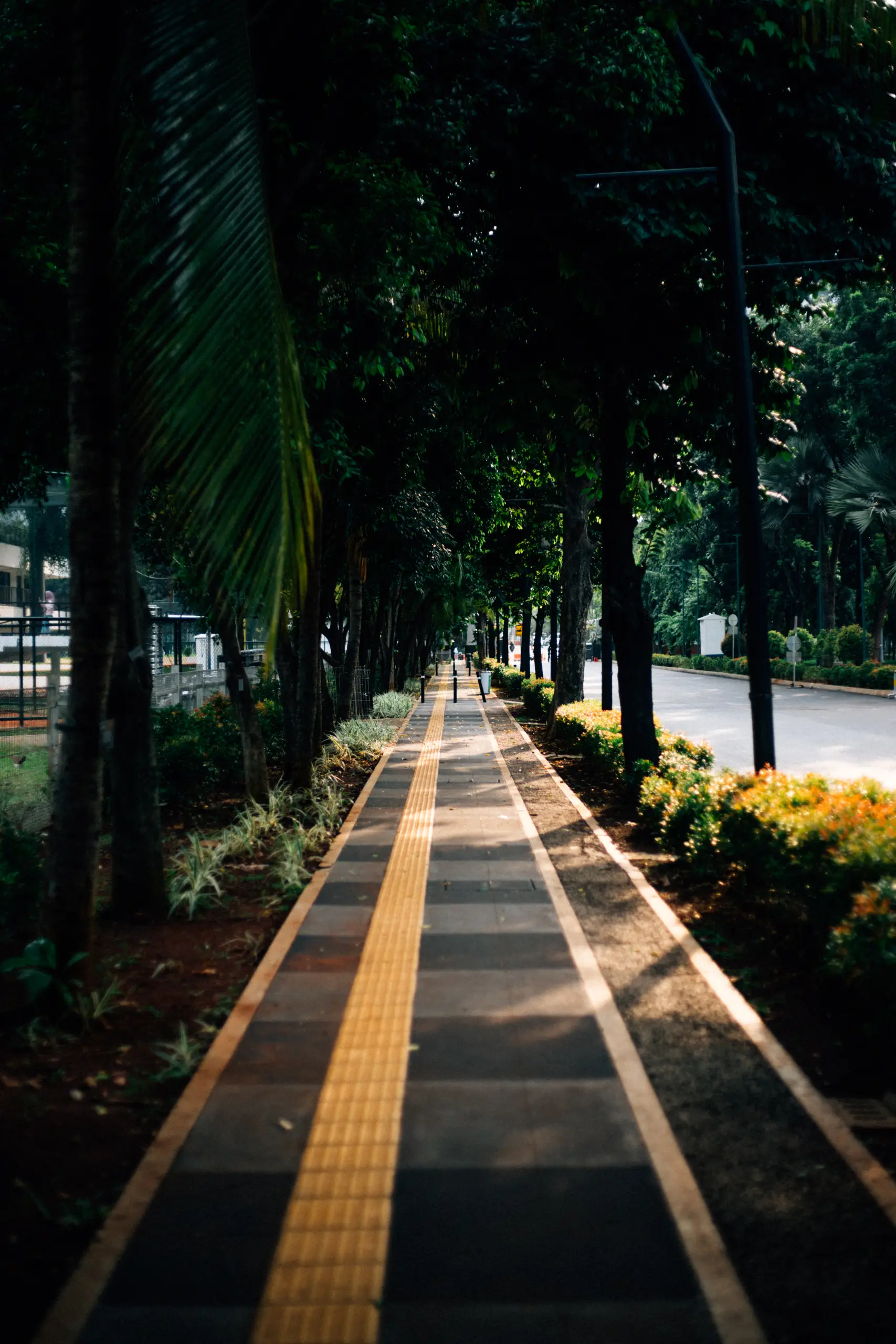
Healthy mobility is also supported by prioritizing pedestrians and cyclists, building 265 km of sidewalks and 103 km of bike lanes. Beyond mobility, we also strive to accelerate the basic rights of citizens through the provision of clean water, waste management, and green open spaces. Thanks to the collaboration of many parties, we successfully built and revitalized 428 parks and 48 urban forests. Consequently, 91% of residents are now only 800 meters away from a city park.
Do not view sidewalks, bike lanes, and parks as mere physical infrastructure. These types of inclusive facilities allow citizens of different social classes to interact with one another, fostering a more harmonious and communal spirit.
Realizing that climate crisis solutions need to be sustainable, existing initiatives were institutionalized through Governor Regulation (Pergub) No. 31/2022 regarding the Detailed Spatial Plan for the Jakarta Provincial Planning Area.
Jakarta is committed to reducing greenhouse gas (GHG) emissions by 30% by 2030. Alhamdulillah, through the various efforts we have implemented, by 2020, greenhouse gas emissions had already been reduced by 26%. These figures are not just a series of statistics in a progress report; they ultimately lead to an improvement in the quality of life for citizens through a healthier environment.
Strengthening collaboration and diplomacy
When discussing the climate crisis, it often stops at being an interesting topic of conversation but fails in execution. The excuse that frequently arises is that this issue is only worth addressing after other matters have been resolved. Such reasoning is completely unacceptable.
Those most impacted by the climate crisis are the poor and the vulnerable. Residents on the Demak coast and the frontier islands of this Republic must bear a massive economic burden because their homes are sinking. Solutions to the climate crisis must instead become a priority because they involve the interests of millions of vulnerable citizens.
What we need in climate crisis solutions today is a sense of partiality toward the people, rather than making it an entry point for vested interests.
These days, we are often asked to normalize situations where business actors also act as regulators. A clear example is right before our eyes: providing subsidies for private electric cars that can only be enjoyed by a few. Meanwhile, the priority should be the expansion and electrification of mass transportation, the impact of which can be felt by all levels of society.
When the climate crisis is used merely as a package to reap profits, the space to realize social justice is pushed aside. We need evidence-based policy, not collusion-based policy. Instead of the state merely acting from a conventional perspective as an administrator, we need to invite citizens to collaborate and become problem solvers. The state cannot solve the climate crisis alone; the keys are collaboration and diplomacy.
It is a mistake to think there is a single solution that can serve as a cure for the climate crisis in various regions. The approach needs to be contextual, like making a suit at a tailor: there is no one-size-fits-all because it must be adjusted to individual needs.
For example, solutions related to forests cannot be generalized. Indigenous communities need to be invited to sit together. Give indigenous peoples the right to speak for themselves. All forms of criminalization against indigenous communities must stop. Indigenous peoples must be protected, not persecuted.
During my time serving in the capital, we began opening doors for collaboration with local communities. Take, for example, the collaboration with the Ciliwung Condet community, which makes humans part of nature by caring for the biological ecosystem along the Ciliwung River. What they built was not just physical infrastructure like concrete walls to fence off the riverbanks; they built a social ecosystem.
Collaboration at the local level needs to be accompanied by diplomacy with the international community. The climate crisis is an issue that transcends national boundaries: it is a problem not limited by territorial borders.
Indonesia must be more active in pushing the climate justice agenda forward. In diplomatic spaces, we must help determine the direction of climate crisis resolution rather than simply being directed.
Thus far, the diplomatic approach has tended to be transactional. We need to move away from the outdated approach of seeing the outside world merely as transactional partners. We cannot simply pawn off our natural wealth to gain bargaining power. When forests are cleared and sea sand is given away, the dignity of this nation gradually erodes.
The promise of the Republic’s founders to “maintain world order” must be fulfilled. We need to be more active in showing our commitment and sharing our experiences in solving the climate crisis so that this Republic can stand as an equal and serve as a lesson for the global community. We have already begun diplomacy for climate justice in the capital. Jakarta is not just the capital of Indonesia: it is a global city.
We were entrusted to serve as the Vice Chair of the Steering Committee in C40, a network of the world’s major cities committed to addressing the climate crisis. In carrying out that mandate, we successfully moved C40 cities to commit to and sign agreements regarding Nationally Determined Contribution (NDC) targets in climate crisis mitigation.
At the C40 forum, we offered ideas directly to UN Secretary-General Antonio Guterres so that cities around the world could play an active role in climate crisis solutions. We pushed the idea that the UN could prepare an effective support scheme between national and subnational levels. The goal is for support from the international community at the national level to also be effectively implemented on a smaller scale in provinces or cities.
When Jakarta succeeds in lowering carbon emissions, it is not just a responsibility to the residents of the capital, but the impact is felt by the entire world.
With the current generation
On paper, the government has planned climate crisis mitigation with ambitious targets. Its implementation must also be carried out seriously. The climate crisis will not be resolved if treated as business as usual. It needs a new idea to handle the climate crisis; the idea we are striving for is climate justice.
Climate justice stems from the promise to realize social justice for all Indonesian people. Social justice will not be achieved if the handling of the climate crisis does not favor vulnerable citizens. Through climate justice, our focus is not only on the economic ecosystem, but on realizing a social ecosystem.
Realizing a social ecosystem means that economy and ecology cannot kill each other; instead, they must walk side by side. Facing the climate crisis is like pedaling a bicycle: one must keep moving forward and cannot go backward. Each stroke must also be stable. This sends a message that economy and ecology can go hand in hand.
We strive to promote climate justice through several ideas. First, mainstreaming the social ecosystem perspective in development. Old ways of development that sacrifice the environment must be stopped. Development must be climate-just.
Second, when irresponsible parties harm climate justice, law enforcement is absolute. There is no room for mafias who exploit the environment. Climate justice is a very long, cross-generational struggle. We need to bequeath a sustainable earth, not a time bomb for the current generation.
The commitment of the current generation toward resolving the climate crisis is highly commendable. Therefore, the third idea we want to push goes beyond a program; it is a collective movement. A movement means collaborating with the current generation to own the problem and become part of the solution. The form of the solution can vary, but the essence is providing space for the current generation to be an essential part of realizing climate justice.
We want environmental awareness to be more than just a form of activism for certain groups; environmental concern needs to be normalized as a new standard and part of everyone’s lifestyle.
It is time to provide space for collaboration for young people to face the climate crisis. The wider the space given to the current generation, the more breakthroughs and innovative solutions will emerge to face the climate crisis. Through this writing, we wish to invite every young person to share their ideas for facing the climate crisis. Allow us to weave togetherness and collaborate in facing the vital problems of the current generation.