
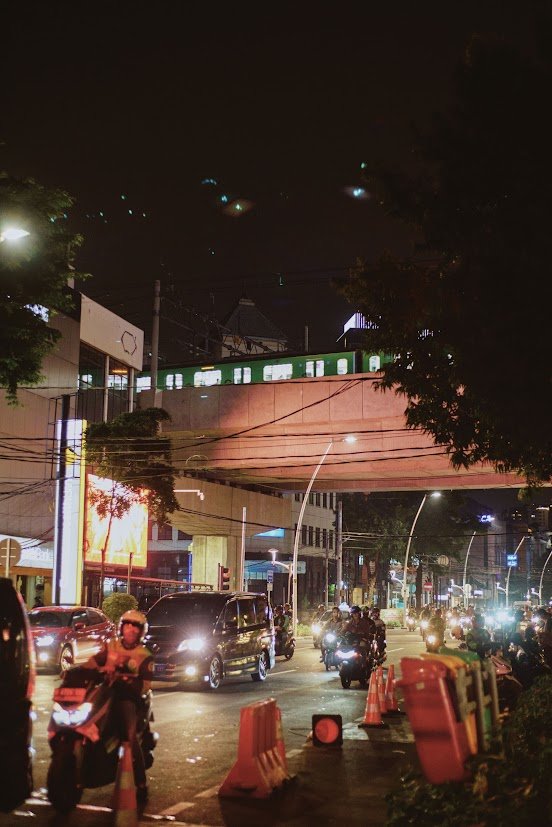
Most streets in Jakarta go empty after seven. Office blocks fall silent as workers head home. Elsewhere, some neighborhoods wake and hum. Blok M gathers late cafés and eateries. Glodok shines through heritage Peranakan culinary and culture. Sabang and Dukuh Atas tailor the modern with vibrant street vendors. A series of small squares and market lanes glow with vendors, businesses, and neighbors.
That uneven and fragmentary map is Jakarta’s real nocturnal urban life.
Together with the City Government and Broadway Malyan, Karsa took a closer look at this opportunity: how to make the city safer, more vibrant, and genuinely inclusive after work hours; how to reshape the evening so it belongs to families, night shift workers, creative youngsters, and the elderly. It is an extensive, multi stakeholder blueprint for nights that live. For people. For business. For an inclusive public realm.
Night-time city making begins from three facts the city knows well: a large share of people have meaningful hours after the working day ends, whether for family time, study, second jobs, or recreation. Second, existing infrastructure such as growing public transport, parks, libraries, and civic spaces is often left underused after sunset. Third, inclusive night activities require an action plan rather than serendipity alone.
Owl Economy policy ensures and preserves what is already working while improving what is not. It is policy and infrastructure that can be designed, managed, and measured. The rest of this essay explains how.
Owl Economy is an integrated approach to night time urbanism that expands public access, economic opportunity, and cultural life after dark while ensuring safety, community agency, and incremental delivery. It refuses two misperceptions. The first is the belief that night equals “nightlife” in the sense of bars and clubs. The second is the notion that night is merely a cultural issue, detached from transport, lighting, or regulation.
Instead, Owl Economy treats night as civic capacity. When a city uses more of its 24 hours intelligently, it unlocks livelihoods and social value while strengthening competitiveness.
Lessons from The Sisters Cities
Bangkok demonstrates how informality could be formalized without losing character. Areas such as Khaosan Road and Chatuchak Night Market were designated as structured night destinations. Through clear zoning, operating hours, and vendor protection frameworks, street food evolved from tolerated activity into a tourism brand and stable local income source. Legal recognition provided breathing room for informal traders while creating regulatory certainty for authorities and visitors.
Seoul illustrates the power of community led curation through the Seoul Bamdokkaebi Night Market. This seasonal market operates through open tenant selection and integrates food, performances, exhibitions, and creative programming. Government acts as enabler, while communities shape content. The result feels embedded rather than imposed. Night activation becomes cultural expression rather than event management.
Tokyo treats night as intentional urban staging. Roppongi Art Night activates public space through curated light installations, multimedia art, and coordinated night transport systems. Government support includes thematic lighting, structured safety protocols, and transport continuity. Lighting and wayfinding function as infrastructure, not decoration.
The study also references Ho Chi Minh City, where culturally rooted night markets contribute significantly to tourism revenue while empowering local economic actors. Night activity strengthens both the visitor economy and micro enterprise ecosystems.
Across these cases, the pattern is consistent. Regulatory clarity precedes activation. Communities curate rather than simply participate. Lighting, safety, and mobility are treated as integrated infrastructure. Night programming reinforces city identity instead of standing as isolated entertainment.
Night-time policy works when regulatory structure meets place sensitive programming, and when safety is designed through urban form, lighting strategy, and coordinated governance, not merely enforced.
What Makes a Convenient Urban Tourism District
There is a rule of thumb that guides the study: 3A+1C, which stands for Accessibility, Amenities, Attractions, and Community.
Accessibility means people could arrive and leave safely and predictably. It requires reliable late-night transit, clear last mile links, and coordination between Public Transport Operator (PTO) to provide seamless connection to use another transportation. Without that hinge, dense pockets of activity remain isolated.
Amenities refer to basic urban comforts that many take for granted in daylight, such as good lighting, toilets, seating, signage, and sanitation. At night, these become decisive. They are not decorative. They are pivotal in making public space legible, comfortable, and safe.
Attractions activate and extend a wide palette of activities. Markets, museum activities, small performance programs, night sports, community learning sessions, and late-night recreation each draw different publics. Evening activity complements what happens during the day.
Community ensures that activation is not purely top down. Local entrepreneurs, cultural groups, and resident associations must become co curators. When communities shape programming, activation feels native and becomes more sustainable.
These four elements must exist together. The Owl Economy framework is as much a question as it is a set of interventions, maintaining organic growth alongside policy enforcement.
Three Poles, Three Conditions
The Owl Economy proposes piloting targeted, measurable experiments that prove concepts before scaling across the metropolis. Rather than a single citywide rollout, the study recommends three distinct poles connected by new Mass Rapid Transit (MRT) and road corridors, each with different readiness and delivery logic.
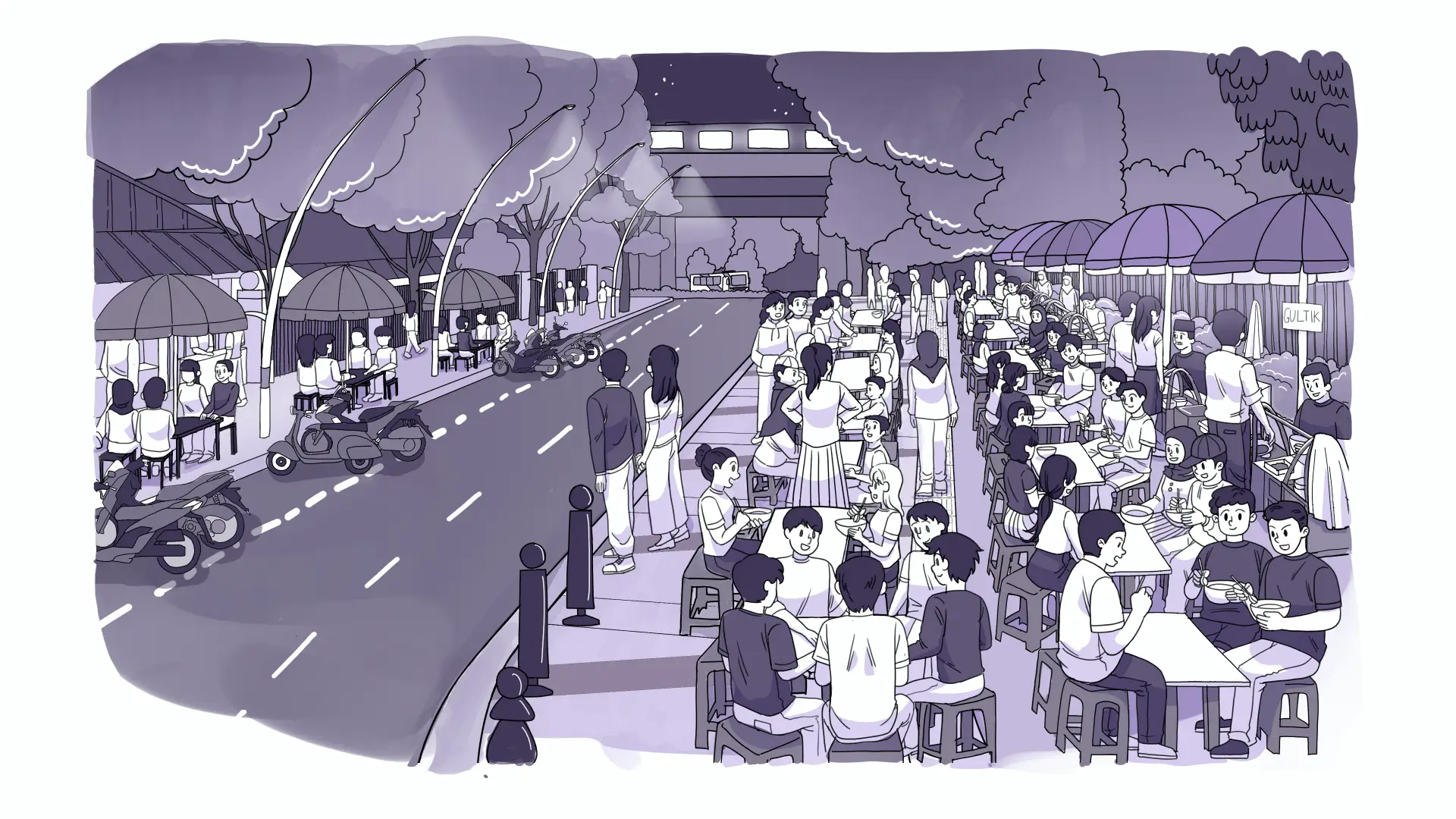
1. Continuing Pole: Blok M-Cipete
Strong collective memory has shaped this area since Lintas Melawai in the 1980s. It hosts youth culture, dense culinary strips, and a small creative economy. The phase here is consolidation, not reinvention.
Interventions are light touch and calibrated to protect authenticity: improving pedestrian comfort and curbside management, clarifying parking and loading rules, upgrading sanitation and waste routines, and providing modest lighting and wayfinding that do not sterilize the street. The aim is to remove friction, such as informal parking conflicts, so the ecosystem could grow steadily without displacement.
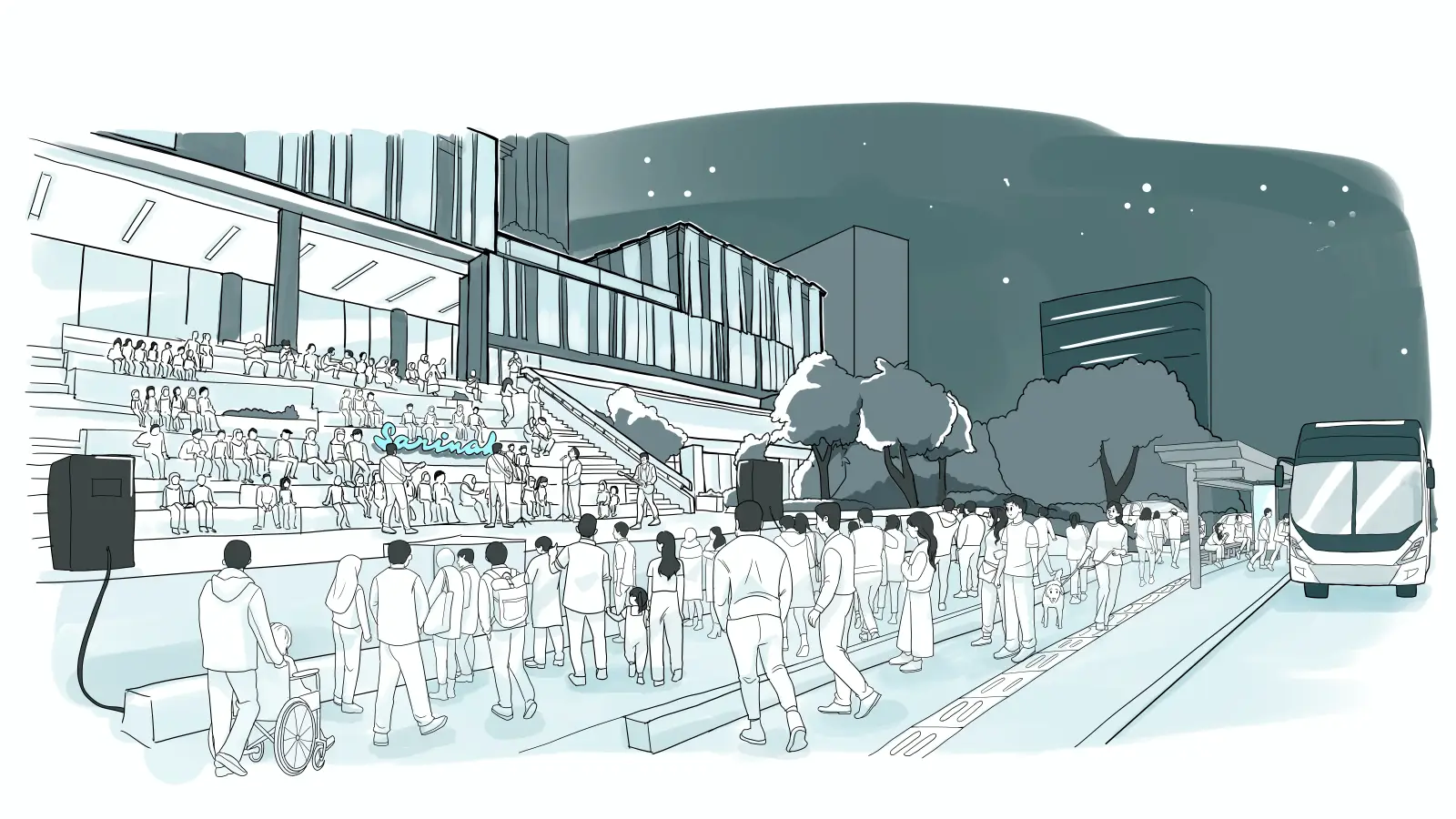
2. Commencing Pole: Bundaran HI-Dukuh Atas-Sabang
This corridor is an interchange of scales. MRT nodes, office towers, and long-standing street traders meet in close quarters. Its value lies in alignment.
Bundaran HI and Sudirman station exits must link seamlessly to street life through pedestrian continuity, guiding lighting, and managed coexistence between formal retail and informal vendors. Short term works should focus on station to street wayfinding, last mile connections, and curated vending clusters positioned alongside formal retail rather than competing with it.
With transport upgrades already underway, modest placemaking and late-night activities such as observatory access at Thamrin Nine, sightseeing in Sarinah, or local food hunting at Jalan Sabang could stitch fragmented activities into a coherent after-hours network.
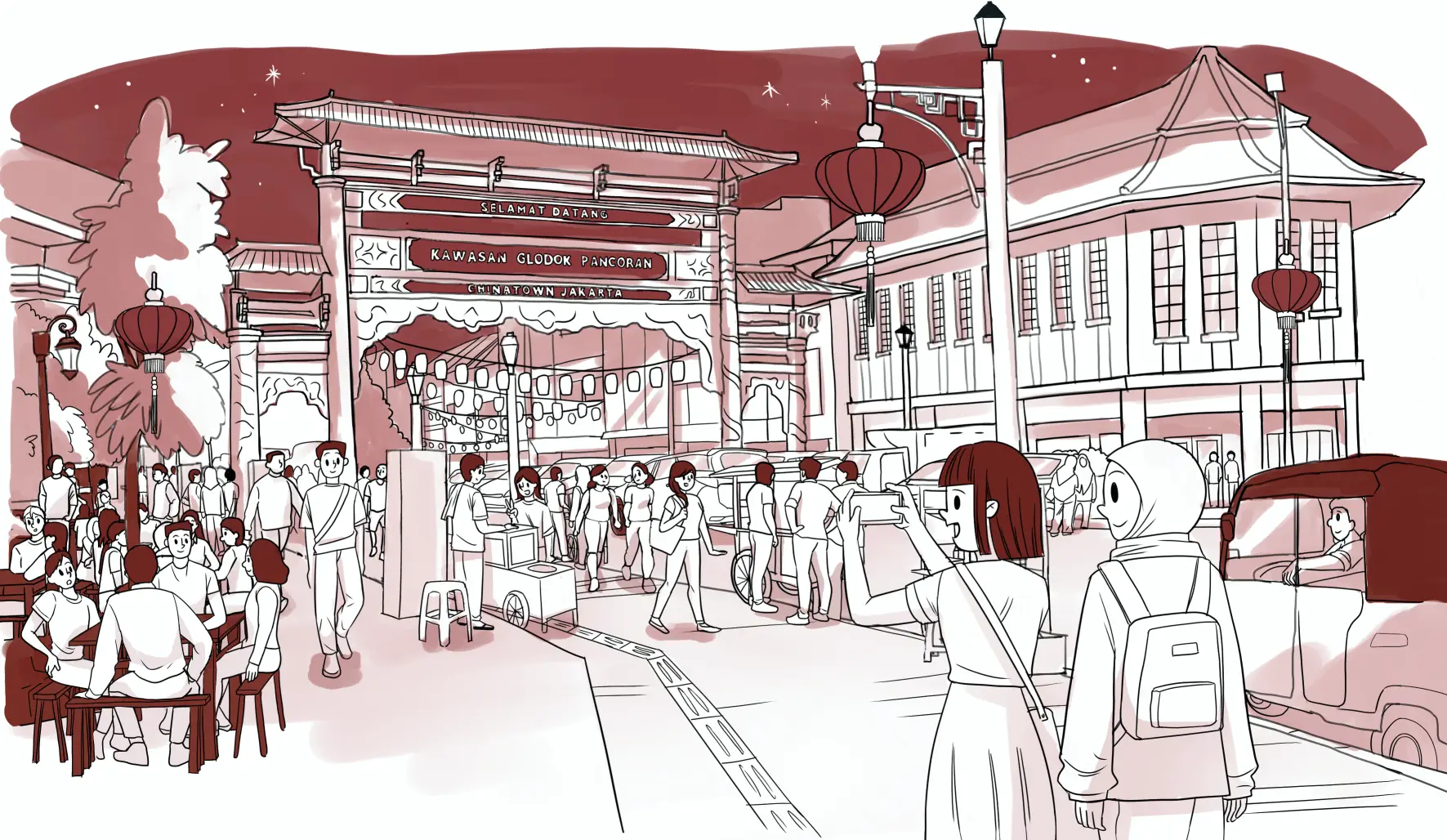
3. Preparation Pole: Glodok-Kota Tua
Glodok-Kota Tua carries deep heritage and narrative potential, but the activation needs to follow the rules. The sequence here is the preparation before programming.
Façade improvements, heritage sensitive lighting strategies, repaired pedestrian links, and tested crowd management systems must precede sustained night activation. Future MRT connectivity will alter demand dynamics. Infrastructure prepared today enables responsible activation tomorrow.
Governance and Delivery
Each pole is treated not as an event site, but as an ecosystem. Lighting improvements, pedestrian continuity, transport reliability, curated programming, and operational clarity function as coordinated adjustments rather than isolated upgrades.
Night-time policy then stabilizes what pilots reveal. Permits, operational standards, and street level management must be clarified so vendors, property owners, and residents understand their roles. Government provides the regulatory baseline, businesses operate within predictable rules, communities participate in shaping acceptable use.
This trihelix structure reduces informal negotiation and replaces it with structured coexistence. The night becomes governable without becoming over controlled.
Measurement matters. Late service ridership, activity levels in designated zones, and small business turnover indicate economic movement. Perception surveys and community feedback indicate whether people feel safe and included. Government adjusts policy, businesses adjust operations, communities respond through participation. The cycle remains continuous.
City branding reflects delivery, not the other way around. Owl Economy is not introduced as a campaign, but as a coordinated system of policy, operations, and participation. A night identity holds only when transport works, improvements are visible, and rules remain predictable.
Scale by stitching, not by forcing top-down uniformity. A single successful night market is valuable. A constellation of distinct night markets, reliable transit links, and digital wayfinding creates metropolitan coherence.
Start small, learn fast, scale up through pilot testing. That is the rhythm of our Owl Economy.
With legal clarity, community curation, transport continuity, thoughtful lighting, and a calendar that values the everyday as much as spectacle, fragmented pulses could be woven into an inclusive and functioning night.
Jakarta could extend its morning bustle into its evenings. It could preserve heritage while creating new gastronomic attractions. It could give small businesses and artists room to grow at night while protecting residents from excessive noise.
The early bird catches the worm.
But in a 24-hour city,
night owls catch the rest.
Everyone can be productive,
Everyone can belong,
Everyone can prosper.