

Public services remain one of the most tangible indicators of the state’s presence in addressing the needs of its citizens. Technology, meanwhile, has increasingly been positioned as a catalyst capable of strengthening that role. Yet an important question remains: have our cities truly leveraged technology to serve their residents more effectively?
The proliferation of digital applications and service platforms across Indonesia has been remarkable. By 2025, Indonesia’s Ministry of Administrative and Bureaucratic Reform (KemenPAN-RB) recorded approximately 27,000 digital applications developed by national and local government institutions. Collectively, these applications represent an estimated public investment of IDR 6.2 trillion, driven in part by the tendency of agencies to commission new platforms whenever leadership changes.
Despite this substantial investment, many of these systems have delivered limited impact. Applications are often developed in isolation, without sufficient integration across agencies or workflows. As a result, overlapping functions, fragmented services, and duplicated efforts have become common challenges. The sheer number of applications, both budgets and function, stands in stark contrast to the actual progress cities and governments have made in addressing the complex challenges they face.
The COVID-19 pandemic provides a notable example. During the crisis, Indonesia’s Ministry of Health (Kemenkes) launched PeduliLindungi, a digital platform designed to support public mobility and health-related services. Citizens used the application to access vaccination records, conduct venue check-ins, report potential exposure, and fulfill travel requirements. Through an integrated digital system, policymakers gained access to mobility data that enabled more effective contact tracing and helped identify potential transmission clusters. While citizens interacted with the platform as users, the application simultaneously generated valuable data that informed public health responses.
Technology in Practice: The Jakarta Experience
At the city level, Jakarta offers a compelling illustration of how technology can be applied to address urban challenges. One example is the city’s flood management system, which utilizes advanced technologies to collect, process, and disseminate flood-related information automatically. The objective is not only to improve flood prediction but also to support more effective emergency response and long-term mitigation strategies.
Serving as a knowledge management system for flood control, the platform leverages Internet of Things (IoT) technology through the deployment of 178 sensors installed across pump stations throughout Jakarta. These sensors monitor rainfall intensity, vibration, temperature, water levels, and water flow conditions. The data generated is then integrated with Artificial Intelligence (AI) systems capable of processing and analyzing information in real time.
The result is a comprehensive monitoring and control mechanism that provides city officials with a clearer understanding of flood risks as they emerge. Beyond serving as an early warning system for residents, the platform also enables the development of data-driven policies, helping decision-makers formulate more informed and effective flood management strategies.
These examples demonstrate that technology can significantly improve the effectiveness of public services while strengthening a city’s capacity to anticipate, respond to, and adapt to urban challenges. However, technological sophistication alone is not enough. Effectiveness must remain the primary benchmark for determining whether a solution truly serves its intended purpose.
Building a Digital Ecosystem as Civic Infrastructure
Within a metropolitan context such as Jakarta, technology has increasingly been positioned as a form of urban infrastructure. One of the most notable initiatives is JAKI (Jakarta Kini). JAKI consolidates more than 50 applications developed by different local government agencies into a single access point, allowing residents to access a wide range of public services through one platform.
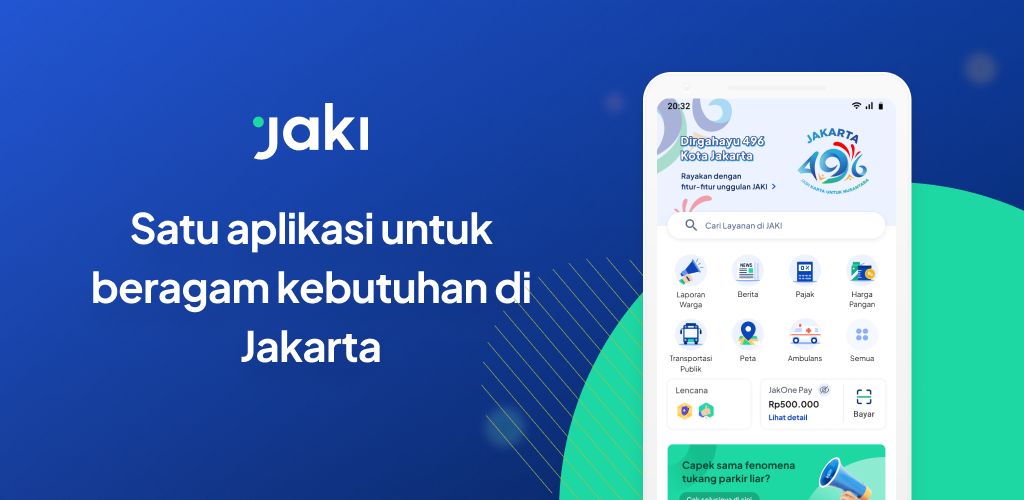
The initiative emerged from a practical challenge: fragmented public services. By integrating multiple services into a single ecosystem, Jakarta sought to simplify access to information, reduce bureaucratic complexity, and create more direct channels between citizens and government.
Among JAKI’s most widely used features is JakLapor, a citizen reporting platform supported by the CRM (Citizen Rapid Response) system. The platform enables residents to report urban issues while allowing government agencies to coordinate responses more efficiently.
In 2025, JakLapor became the most actively used feature within the JAKI ecosystem, recording 174,417 reports submitted by 36,870 users. More recently, in May 2026 alone, the platform received 20,223 reports from 8,810 residents. Of these, 19,906 reports were successfully resolved, covering issues ranging from road conditions and illegal parking to waste management, social disturbances, and traffic-related concerns.
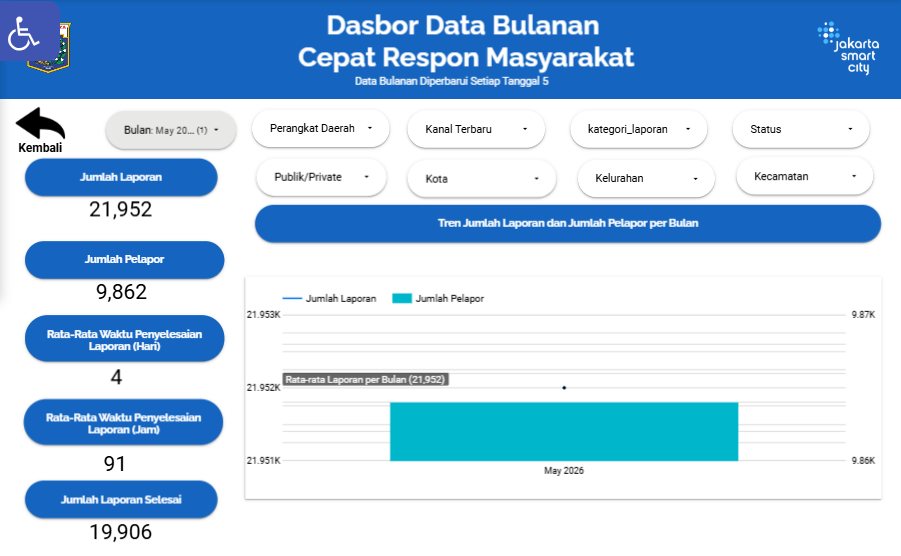
These figures represent more than service utilization statistics; they reflect meaningful civic participation. Citizens are no longer merely consumers of public services. They are also contributors of information that helps governments better understand urban conditions and make more informed decisions. In this sense, citizen participation has become a critical component of modern urban infrastructure.
Participation and Collaboration: How Cities Respond?
JAKI’s development was guided by three core principles: Open API policies, collaborative system development, and service integration. Prior to JAKI, government agencies managed their own datasets across fragmented and often incompatible systems. Jakarta’s provincial government responded by standardizing and integrating these datasets into a shared ecosystem while making them accessible through Open APIs. This approach enabled greater interoperability across institutions and created opportunities for collaboration with external developers and stakeholders.
Collaboration became a defining principle of the platform’s development. Government agencies contributed data, technology developers helped build solutions, and citizens actively participated by reporting urban issues. Together, these actors formed a digital ecosystem that extends beyond government alone.
At the heart of this transformation lies not technology itself, but the ability to manage data effectively. Cities generate millions of data points every day through government operations and citizen interactions. When that data can be integrated, shared, and utilized strategically, governments gain a far greater capacity to deliver responsive, citizen-centered services.
For this reason, building a participatory city requires more than simply providing complaint channels. Governments must ensure that every report is followed up, every dataset is translated into actionable knowledge, and every digital innovation delivers tangible benefits. At the same time, citizens must view digital participation not merely as a right, but as a shared responsibility in improving the city.
Ultimately, the success of digital public services can be distilled into three fundamental elements: technological quality, citizen adoption, and tangible impact. When these elements work in tandem, technology ceases to be just another application on a smartphone. Instead, it becomes a bridge that connects citizens’ needs with the government’s ability to respond.
The rise of AI offers a timely example. Increasingly used as a personal assistant capable of helping individuals solve everyday problems, AI represents a new approach to addressing complexity. Cities can adopt the same logic, applying AI to navigate urban challenges across multiple sectors, including public service delivery.
However, the experience of cities worldwide demonstrates that success is never determined solely by technological sophistication. Impact is created only when technology is actively adopted and meaningfully used by the people it is designed to serve.
In this regard, the formula for successful digital public services can be summarized as:
Effective Digital Public Services = Technology Quality + Policy Framework + Citizen Adoption
When guided by these principles, digital transformation becomes more than a technology project. It becomes the foundation for building cities that are more responsive, participatory, and capable of evolving alongside the needs of their residents.